
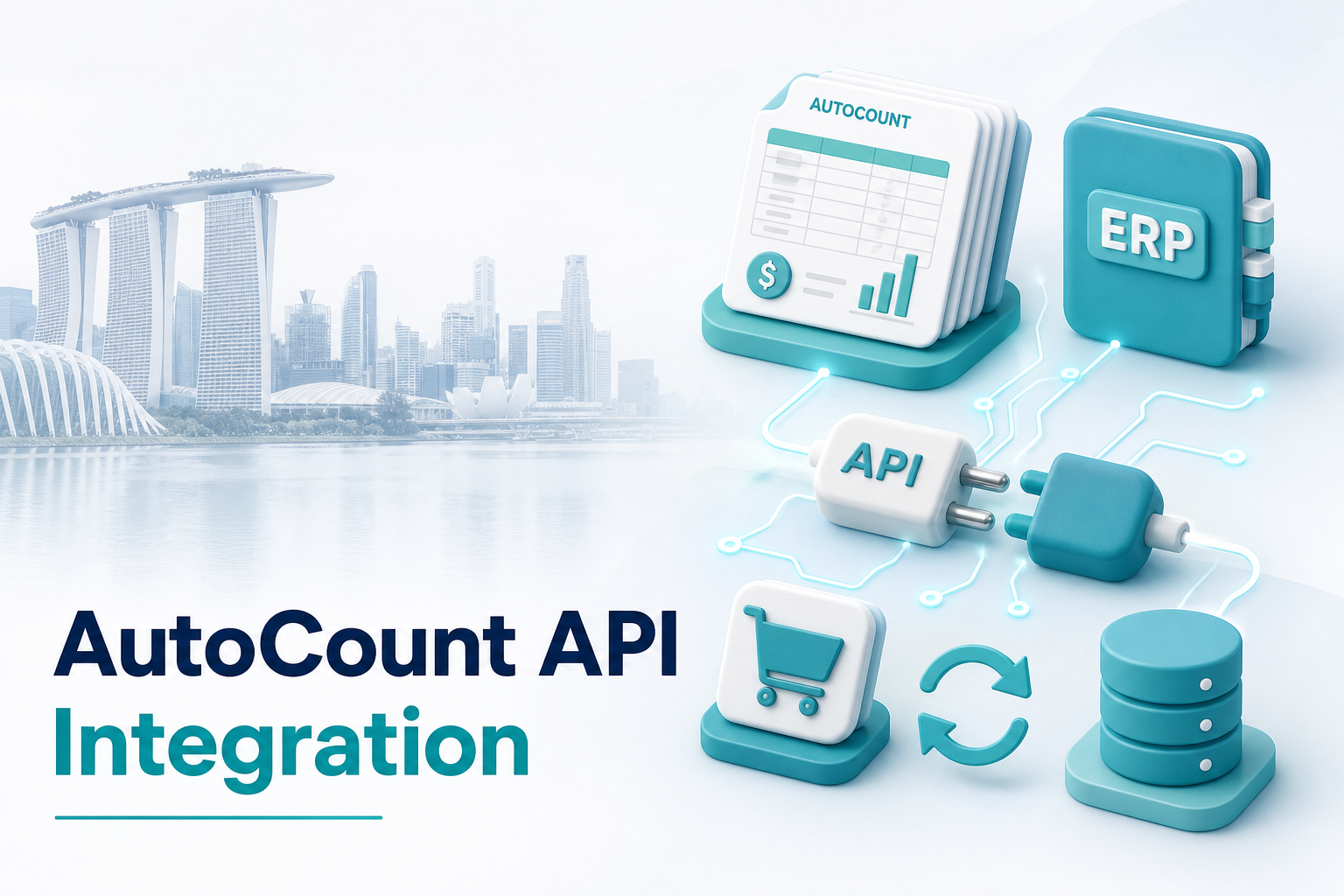
AutoCount API integration is how Singapore HQ teams keep finance, stock, and sales data aligned when operations run across portals, marketplaces, and regional subsidiaries. Manual CSV exports rarely survive volume, audit expectations, or multi-branch rules.
What AutoCount API integration actually means
In practice, integration means a controlled bridge between AutoCount (via vendor APIs or governed SQL surfaces) and the systems your teams use daily—WooCommerce or B2B portals, CRM pipelines, wholesale ordering apps, and accounting sync for Singapore entities.
Good middleware validates mappings before anything posts to AutoCount: customers, SKUs, tax codes, credit limits, and document types. Idempotent writes and exception queues matter as much as the happy-path sync.
Common Singapore use cases
- Ecommerce to AutoCount — paid orders become sales orders or invoices with stock reservation and debtor updates.
- CRM and sales — credit terms and invoice status flow back so sales does not live in two systems.
- Wholesale and B2B portals — customer-specific pricing and consolidated billing post without re-keying.
- Cross-border groups — Singapore entities on Xero while regional subsidiaries stay on AutoCount, with explicit master-data ownership.
For Singapore cloud accounting programmes, see also our guide to Xero API integration.
What to lock in discovery
Before build, finance and IT should agree on:
- Chart of accounts, branches, and document types that middleware may create
- Source of truth for stock and customer master data
- Retry, dead-letter, and daily reconciliation rules
- Staging cutover and UAT sign-off by finance—not only IT
Why CSV bridges fail at scale
CSV handoffs hide timing errors, create duplicate journals, and leave no audit trail when stock and invoices disagree. Event-driven sync with human-readable error reasons is the baseline Singapore finance teams should expect from a production programme.
How Xantec delivers
Xantec’s AutoCount API integration programmes are delivered under Singapore-registered contracts. We scope mappings in discovery, build observable middleware, and hand over runbooks your team can operate after go-live.
Ready to connect AutoCount to your stack? Talk to Xantec with a systems diagram and approximate transaction volumes.