
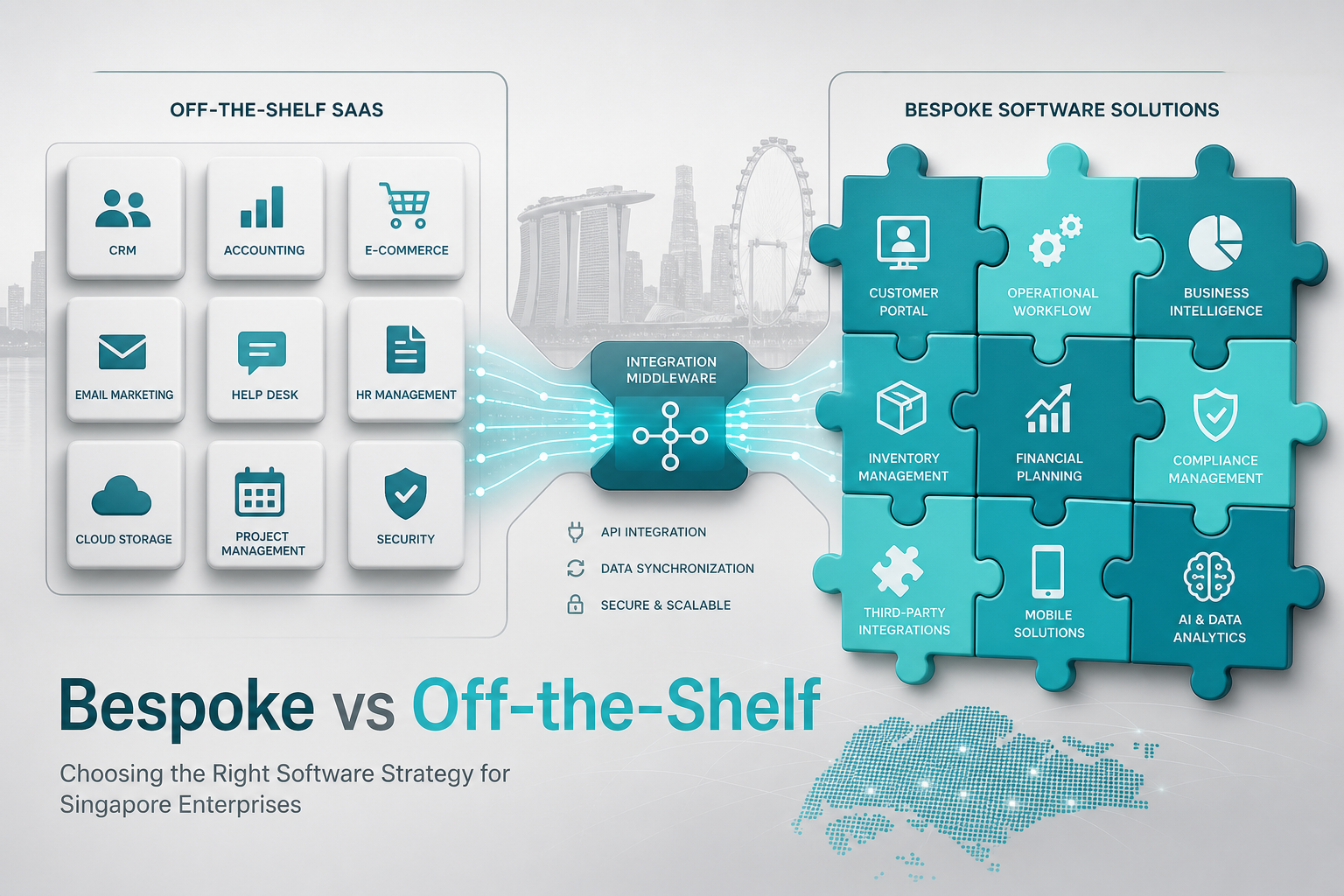
Singapore enterprises rarely face a pure build-versus-buy decision. The practical question is which capabilities should run on proven SaaS products—and where bespoke software creates defensible advantage.
When off-the-shelf wins
Standard SaaS fits well for horizontal needs with mature vendors: accounting (Xero), email and collaboration, generic CRM patterns, and payroll where local rules are already modelled. Buying accelerates time-to-value when your processes can adapt to the product without heavy customization.
When bespoke software is justified
Custom development makes sense when:
- Workflow is a competitive differentiator (pricing engines, allocation logic, partner portals)
- You must orchestrate multiple systems with business-specific rules
- Compliance or audit trails require controls SaaS cannot configure
- Regional operations (SG + MY) need one tailored operations layer
Building also pays off when integration costs to bend SaaS exceed a focused custom module.
The hybrid approach most teams land on
A common pattern for Singapore businesses:
- Keep core finance and HR on established platforms
- Build a custom operations or customer layer that orchestrates data
- Use API middleware for accounting, logistics, and messaging
This limits vendor lock-in while avoiding rebuilding commodity features.
Hidden costs of “configure only”
SaaS customization fees, per-seat growth, and consultant hours for upgrades add up. Model five-year TCO including internal time for testing each vendor release. Sometimes a narrower custom app with fewer seats is cheaper than forcing an enterprise suite to behave unlike its defaults.
Risk and ownership
Custom projects demand clear IP ownership, documentation, and test coverage. SaaS shifts operational risk to the vendor but reduces control over roadmap timing. Your procurement team should score both models against business continuity requirements.
Making the decision with stakeholders
Run a short discovery workshop with operations, finance, and IT. List non-negotiable workflows, integration points, and reporting needs. Score each option against time, cost, flexibility, and risk—not only initial licence fees.
Need an independent view?
Xantec helps Singapore enterprises scope build, buy, and integrate paths—including API integration and industry solutions such as CRM and wholesale ordering. Contact us for a neutral assessment.